The IMPACT Framework
A six-stage methodology that takes any goal — from a company's strategic objective to an individual's daily habit — and turns it into consistent, measurable progress. Built on goal science, habit research, and AI.
01
Identify
Focus on what truly matters
02
Motivate
Connect goals to purpose
03
Plan
Build the path, not just the destination
04
Act
Move every day with intelligent support
05
Check
Measure what matters in real time
06
Transform
Learn, adapt, and raise the standard
Definition
What is the IMPACT Framework?
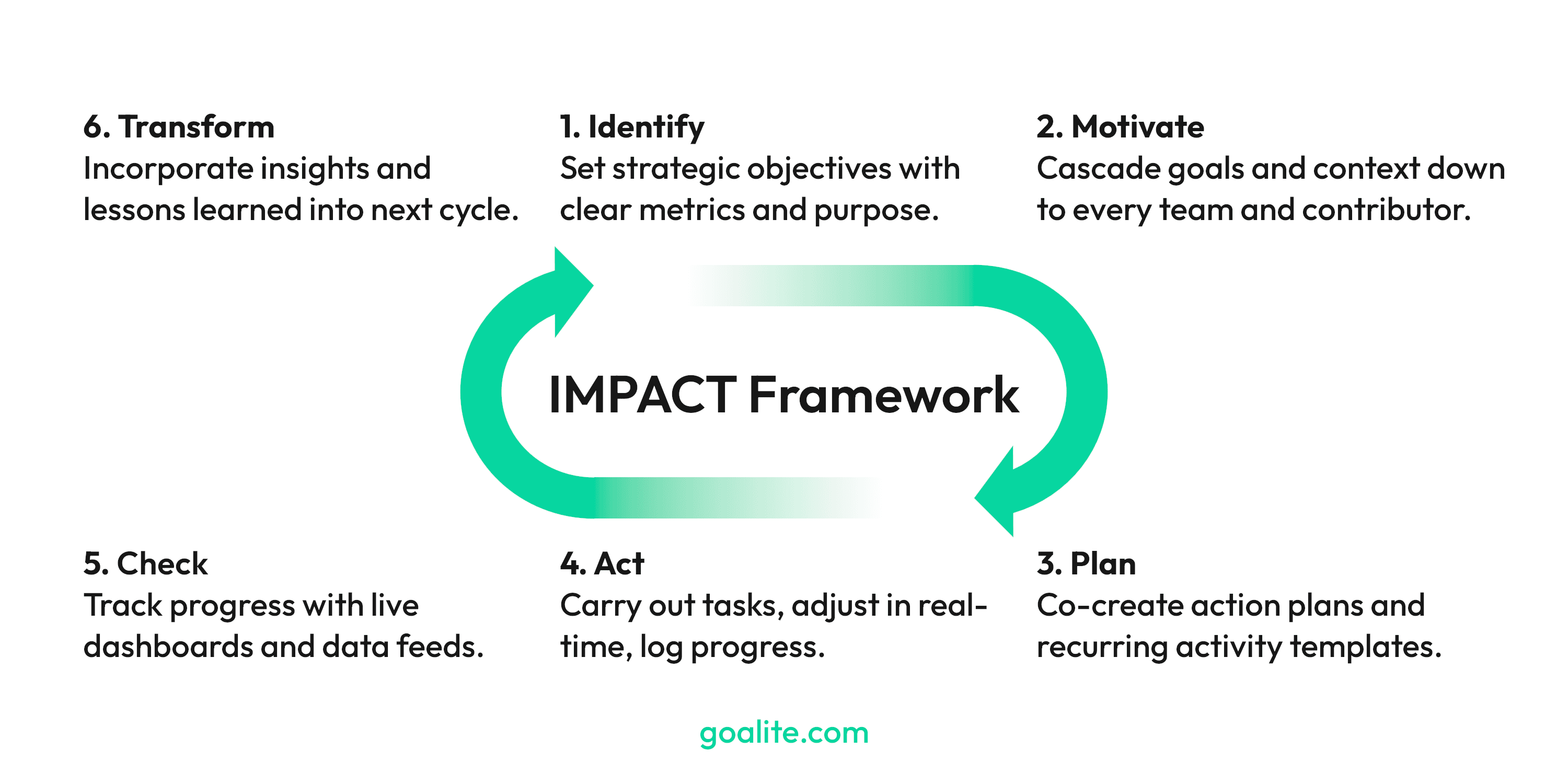
The IMPACT Framework is Goalite's proprietary six-stage methodology for goal execution. Each letter represents a stage in the journey from identifying what matters to transforming outcomes into lasting capability. The framework applies at individual, team, and organisational level.
The framework is grounded in academic goal-setting theory, decades of research in habit formation and sustained behaviour change, and evidence from OKR implementation research. It draws on established findings in motivation science — including the importance of purpose in goal persistence — and behavioural research into how daily habits compound over time. Unlike SMART goals, which focus narrowly on the structure of a single goal, IMPACT addresses the full execution cycle — including motivation, daily behaviour, progress measurement, and learning.
Unlike OKR frameworks, which are primarily organisational planning and reporting tools, the IMPACT Framework extends to individual daily behaviour change. It is designed to close the gap between strategy (what organisations decide to do) and execution (what individuals actually do every day).
The IMPACT Framework is a six-stage goal execution methodology developed by Goalite: Identify, Motivate, Plan, Act, Check, Transform.
Unlike SMART goals or OKRs, the IMPACT Framework focuses on behaviour change and continuous adaptation — not just goal setting and reporting.
The IMPACT Framework is the methodology that underpins Goalite's AI goal execution platform, applicable at individual, team, and organisation level.
Stage 1 of 6
I — Identify
Focus on what truly matters
Definition
Identify is the first stage — determining which ambition deserves your focus right now and clarifying it with enough precision that it becomes actionable, while preserving the purpose and meaning that makes it worth pursuing.
In practice
Most goal-setting begins with a target and works backwards. Identify begins with a harder question: of all the things you could pursue, which one, if achieved tomorrow, would have the biggest impact? Only once the right goal is chosen does the stage move to articulating what success genuinely looks like — connecting intent to evidence before any planning begins.
Goalite implementation
Goalite's AI asks structured questions to help individuals and teams surface the ambition that matters most, then articulate it with clarity — connecting the what to the why before any planning begins.
Stage 2 of 6
M — Motivate
Connect goals to purpose
Definition
Motivate embeds the reason behind the goal into the structure of the plan — so motivation is systemic, not dependent on willpower or mood.
In practice
Research in motivation science consistently shows that goals connected to meaningful personal or organisational purpose have significantly higher completion rates than goals defined purely by outcome. This finding is well-established across goal-setting theory (Locke & Latham, 1990) and self-determination research. The Motivate stage makes this connection explicit — for individuals (personal values and ambition), for teams (shared mission), and for organisations (strategic intent).
Goalite implementation
Goalite surfaces the purpose context throughout the journey — in daily nudges, progress check-ins, and milestone celebrations — not just at the moment the goal is set.
Stage 3 of 6
P — Plan
Build the path, not just the destination
Definition
Plan converts the goal into a structured sequence of milestones, steps, and recurring habits — a roadmap that is specific enough to act on and flexible enough to adapt.
In practice
A goal without a plan is a wish. The Plan stage uses AI to break any goal — from a company OKR to a personal objective — into a concrete, time-sequenced plan. Critically, the plan includes daily habits, not just milestones, because behaviour change happens in daily repetition.
Goalite implementation
Goalite’s AI engine takes a natural language goal description and generates a milestone plan, step-by-step actions, and suggested daily habits — personalised to the individual’s role, context, and capacity.
Stage 4 of 6
A — Act
Move every day with intelligent support
Definition
Act is the daily execution stage — where plans become behaviour, habits become routine, and progress is made visible.
In practice
The Act stage is where most goal frameworks fall down. They are built for planning, not for daily engagement. IMPACT’s Act stage is designed for the working day — brief, focused, and embedded in existing routines. AI nudges provide timely support without creating new administrative overhead.
Goalite implementation
Goalite surfaces daily actions inside Microsoft Teams and via mobile — habit check-ins, AI encouragement, and daily goal focus — so execution happens in the flow of work, not in a separate platform.
Stage 5 of 6
C — Check
Measure what matters in real time
Definition
Check is the continuous progress monitoring stage — providing individuals, managers, and leaders with the visibility they need to stay on track and course-correct early.
In practice
Most performance management is retrospective. Annual reviews and quarterly OKR check-ins tell you what happened. The Check stage is designed for real-time visibility — progress dashboards, completion rates, and early warning signals — so that interventions are timely.
Goalite implementation
Goalite’s dashboards give individuals a live view of their own progress and give managers visibility across their teams — without requiring manual reporting or status updates.
Stage 6 of 6
T — Transform
Learn, adapt, and raise the standard
Definition
Transform converts the learning from each goal cycle into improved capability — making the next goal faster to plan, easier to execute, and more likely to succeed.
In practice
Goals that are completed without reflection are missed learning opportunities. The Transform stage involves structured review: what worked, what didn’t, what should change in the next cycle. Over time, this compounds — individuals become better goal-setters, teams develop execution habits, organisations build strategic capability.
Goalite implementation
Goalite’s AI analyses progress data across the cycle and provides structured insights at completion — recommendations for the next goal, habit adjustments, and team-level learnings for managers.
Framework comparison
IMPACT vs other frameworks
| Capability | IMPACT | SMART Goals | OKR Framework |
|---|---|---|---|
| Covers daily behaviour | |||
| Applies at individual level | |||
| Motivation / purpose built in | |||
| AI-adaptive | |||
| Real-time progress | |||
| Covers full execution cycle | |||
| Suitable for organisations |
The IMPACT Framework is not a replacement for OKRs at the strategic planning level — it is the execution layer that sits underneath strategic frameworks. Organisations can use OKRs for objective setting and alignment while using IMPACT (via Goalite) for the daily execution that turns those objectives into results.
Use cases
The IMPACT Framework in action.
Individual: developing leadership skills
A marketing manager sets a goal to improve their leadership capability over six months.
- I
Identify
Defines the goal: "Become a more effective team leader." Articulates what success looks like — improved feedback scores, more confident one-to-ones, increased team autonomy.
- M
Motivate
Connects the goal to personal ambition (promotion readiness) and team impact (a better-led team delivers better work).
- P
Plan
AI generates a milestone plan: complete a leadership course by month 2, run weekly one-to-ones from month 1, seek 360-degree feedback at month 3. Daily habits include 15 minutes of leadership reading and one coaching question per day.
- A
Act
Daily habit check-ins appear in Teams. AI nudges encourage consistency. Weekly reflections prompt pattern recognition.
- C
Check
Progress dashboard shows habit streaks, milestone completion, and self-rated confidence scores over time.
- T
Transform
At six months, AI reviews the cycle: habits that stuck, milestones achieved, areas for the next cycle. The manager sets their next goal with better self-awareness and established routines.
Organisation: improving NPS by 20%
A 300-person SaaS company sets a strategic objective to improve Net Promoter Score by 20% within 12 months.
- I
Identify
The executive team defines the objective with clear success criteria: NPS from 32 to 38.4. They articulate why — retention risk, competitive positioning, and customer-led growth.
- M
Motivate
Purpose cascades: product team connects to "build what users love," support connects to "resolve faster, resolve right." Each department understands the strategic why.
- P
Plan
AI cascades the objective into department goals, team milestones, and individual actions. A support team leader gets a plan to reduce first-response time; a product manager gets a plan to close the top 5 feature requests.
- A
Act
Individual contributors receive daily actions in Teams and mobile. A support agent has a habit to review one escalated ticket for lessons learned. A product designer has a habit to review one customer interview transcript daily.
- C
Check
Executives see real-time progress across all cascaded goals. Department heads see their team completion rates. Individuals see their own streak and milestone data. No one writes a status report.
- T
Transform
At the quarterly review, AI surfaces cross-team insights: support improvements correlated with NPS gains, product changes that moved the needle. The next quarter's plan starts from a higher baseline of organisational capability.
FAQ
Frequently asked questions
The IMPACT Framework — free PDF guide
Download the full methodology: all six stages, the science behind them, and how to apply them to your goals.
Email required
Explore Goalite