Strategic goal execution
The strategy-to-execution gap. And how to close it.
Most organisations have a strategy. Most organisations do not have a system for executing it. Decisions get made at the top, communicated once, and then left to find their own way to the front line — which they usually don’t. This page explains what it actually takes to close the gap between what your company plans and what your people do.
Definition
What is strategic goal execution?
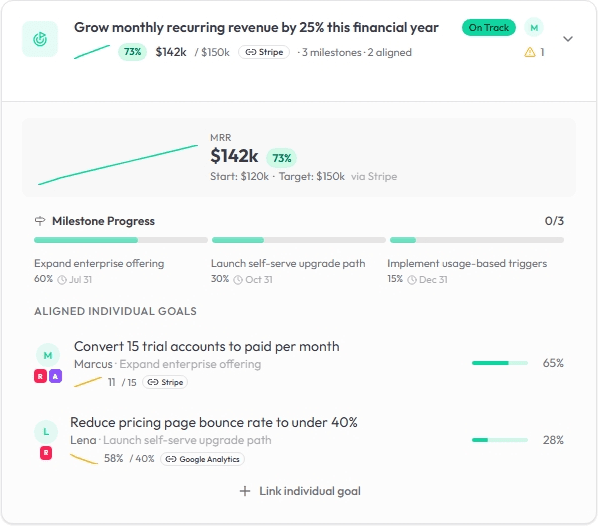
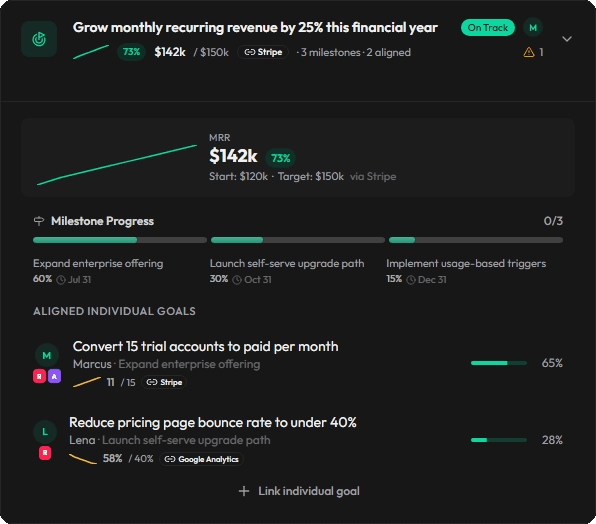
Strategic goal execution is the process of turning an organisation’s high-level strategic objectives into individual daily actions across every team and employee. It goes beyond traditional goal setting: it is the discipline of ensuring that every objective — from a board-approved strategic priority to a team-level key result — drives tangible, daily behaviour at every level of the organisation.
The mechanism is a cascade. Strategy must flow top-down — from company to department to team to individual — with each level owning objectives that are clearly derived from the level above. Simultaneously, progress and intelligence must flow bottom-up: individual actions generate data that rolls into team progress, department performance, and ultimately a real-time picture of whether the organisation’s strategy is actually being executed. Both directions are essential. Without the downward cascade, individuals work in isolation from strategy; without the upward flow, leaders are blind to reality.
This is hard because strategy is abstract and individuals are concrete. A board-level ambition such as “become the market leader in customer retention” does not naturally decompose into a Thursday to-do list. The connection requires deliberate structure — a framework for decomposition, technology that automates the cascade, and daily reinforcement that keeps individual behaviour aligned with organisational intent over weeks, months, and quarters.
The cost
How much the gap really costs
The strategy-to-execution gap — the failure of strategic intent to translate into individual behaviour — affects 70% of organisations and costs approximately £8,800 per employee per year.
70 %
McKinsey
Seventy per cent of strategic initiatives fail to meet their objectives. Not because the strategy was wrong, but because execution broke down somewhere between the boardroom and the front line. Goals were approved, communicated once, and then left to drift — with no system to turn intent into daily behaviour.
< 50 %
Gartner
Fewer than half of employees can name their company’s top strategic priorities. If the people responsible for executing strategy don’t know what it is, execution is impossible. This isn’t a communication problem — it’s a structural one. Strategy sits in slide decks and leadership offsites; it rarely reaches the daily to-do list.
£8,800
ONS / McKinsey
The productivity cost of strategic misalignment is estimated at £8,800 per employee per year. Multiply that across a mid-market organisation with 500 employees and the gap costs £4.4 million annually — not in direct spend, but in effort that never connects to outcomes.
Why execution fails
Four reasons strategy never reaches the front line
Goals are set but not cascaded to individuals
Leadership defines company-level objectives, but the cascade stops at department heads. Individual contributors never receive goals that connect to the wider strategy, so their daily work is guided by habit and proximity rather than strategic intent.
No daily mechanism connects objectives to behaviour
Even when goals are cascaded, there is rarely a system that translates a quarterly objective into a today action. Without a daily mechanism — planning prompts, habit nudges, progress check-ins — goals become aspirational rather than operational.
Reporting tools show status; they don’t change it
Dashboards tell you where you are. They don’t tell individuals what to do next. Most strategy execution tooling focuses on visibility for managers, not behaviour change for employees. The result: leaders can see the gap, but the gap doesn’t close.
Annual reviews are too infrequent to course-correct in time
When progress is reviewed annually or even quarterly, the feedback loop is too slow. By the time misalignment is identified, weeks or months of effort have been misdirected. Effective execution requires continuous, lightweight course-correction — not periodic post-mortems.
Requirements
What strategic goal execution software must do
Goal cascade from organisation to individual
The ability to flow a company-level strategic objective down through departments, teams, and individual contributors — with each level owning goals that are clearly derived from the level above.
Daily action mechanism
A system that converts objectives into daily behaviours: planning prompts, habit suggestions, micro-commitments, and check-ins that keep individuals connected to their goals every working day.
AI-powered planning
Intelligent goal decomposition that takes a high-level objective and generates milestones, steps, and habits personalised to the individual’s role, capacity, and timeframe.
Real-time visibility
Upward-flowing progress data that gives managers and leaders a live view of execution health — not a monthly snapshot, but a continuous signal of whether strategy is being enacted.
Microsoft 365 integration
For enterprise organisations, goal execution must live where work already happens. Native integration with Teams, Outlook, and the Microsoft ecosystem removes friction and drives adoption.
Behaviour change focus
Strategy execution is ultimately a behaviour change problem. The software must embed behavioural science — nudges, streaks, reflections, coaching prompts — to sustain new habits over time.
Our approach
How Goalite approaches strategic goal execution
Goalite was built to solve the strategy-to-execution gap directly. The platform combines the IMPACT Framework — a six-stage methodology for goal execution (Identify, Motivate, Plan, Act, Check, Transform) — with AI-powered planning that decomposes strategic objectives into individual milestones, steps, and daily habits. The result is a complete board-to-desk goal cascade: strategy flows from leadership through every team to every individual, and progress flows back up in real time.
For enterprise organisations, Goalite integrates natively with Microsoft 365 — Teams, Outlook, and the broader ecosystem — so that goal execution lives where work already happens. Daily nudges, progress check-ins, and AI coaching drive behaviour change at the individual level, while real-time dashboards give leaders continuous visibility into whether strategy is being enacted, not just planned.
FAQ
Frequently asked questions
Explore the platform